
July-August, Volume 87, No. 4
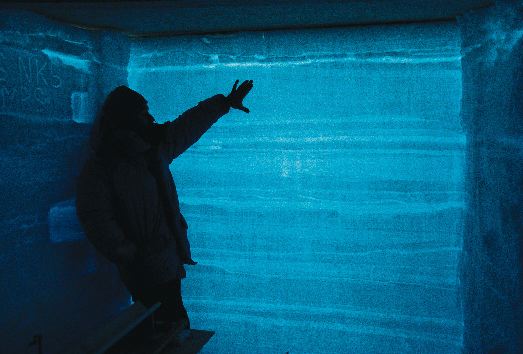
Figure 1. Although earth’s climate has long been known to experience warm and cold phases, earth scientists have assumed that changes in climate take place only very slowly. Surprisingly, however, recent ice-core studies in Greenland and Antarctica, along with corroborating evidence from ocean-sediment cores, have established that as recently as 11,650 years ago, a change in average temperature as great as 10 degrees Celsius may have occurred within 20 years. This realization has led to a new understanding of earth’s climate as existing in three phases, which are relatively stable until perturbed to the point of a precipitous change. The author and other paleoclimate investigators are concerned that anthropogenic additions of carbon dioxide to earth’s atmosphere may alter the hydrologic cycle of the North Atlantic sufficiently to trigger a rapid switch from the present warm climate to a cold one. In this snow pit at Greenland’s summit, light from an uncovered, adjacent snow pit shines through the layers of snow. The thick, dark bands of snow were deposited during the winter; the sequences of thin, lighter bands were deposited during the summer. These visual differences occur because the summer and winter snow have a different density and crystal shape. (Unless otherwise noted, photographs by the author.)