
July-August, Volume 87, No. 4
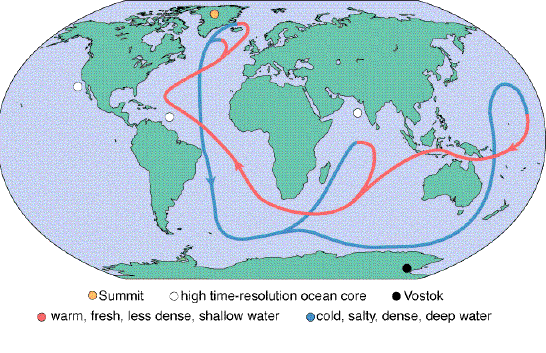
Figure 8. Ocean currents continually exchange water throughout all the oceans and from the surface to the depths, much like a liquid conveyor belt. In the current mode, warm water (red) flows northward along the East Coast of the U.S. toward Iceland. The warm water exchanges heat with the cooler air, becoming cooler and saltier. Near Iceland, the water becomes more dense (cool and salty) than the water below and sinks, flowing southward along the floor of the Atlantic. From there it continues around the Horn of Africa and, still near the bottom, flows into the North Pacific, where it upwells to the surface. Surface water in the North Pacific makes room for the upwelling bottom water by moving south, passing between Asia and Australia and finally catching the tail of the circulation pattern at the beginning of the Gulf Stream in the Atlantic off Central America. There are also places around Antarctica where surface water sinks to great depths; these are not shown because their location and magnitude are less well established than those in the North Atlantic. Two other modes of ocean circulation exist, which correspond to different intensities of ice-age climate. During most of the the Wisconsin ice age, surface water sank only south of Iceland; there was no sinking north of Iceland as shown here. This reduced the amount of water that was circulated by the conveyor. During the coldest times of the last ice age (indicated by the dots in Figure 7), the surface water did not sink in the North Atlantic, and only a small amount of water, if any at all, was circulated by the conveyor.